The global demand for reliable reproductive health diagnostics has positioned pregnancy test kit manufacturers as critical pillars in the healthcare supply chain. These specialized manufacturers bridge the gap between complex biochemical research and accessible consumer health, ensuring that millions of individuals worldwide have immediate, private, and accurate access to hormonal detection. By leveraging advanced lateral flow assay (LFA) technology, these producers enable early detection of human chorionic gonadotropin (hCG), which is essential for timely prenatal care and family planning.
From a global economic perspective, the industry is characterized by a shift toward high-sensitivity reagents and sustainable manufacturing processes. As regulatory bodies like the FDA and CE tighten their quality control requirements, pregnancy test kit manufacturers are investing heavily in R&D to reduce false positives and negatives. This evolution is not merely technical; it is a humanitarian necessity, as accurate diagnostic tools reduce maternal health risks and empower women to make informed decisions about their reproductive futures.
However, the industry faces ongoing challenges, including the volatility of raw material costs for nitrocellulose membranes and the need for more eco-friendly plastic cassettes. Understanding the operational standards and innovation cycles of leading pregnancy test kit manufacturers allows healthcare providers and distributors to source products that balance cost-efficiency with clinical precision, ultimately improving patient outcomes across diverse socioeconomic landscapes.
The Global Role of Pregnancy Test Kit Manufacturers
The influence of pregnancy test kit manufacturers extends far beyond the production of a simple plastic device. They are the primary architects of rapid diagnostic accessibility, transforming the complex science of immunology into a user-friendly format. By adhering to ISO 13485 standards, these manufacturers ensure that every batch produced meets rigorous safety and efficacy benchmarks, which is vital for maintaining public trust in over-the-counter medical devices.
Furthermore, these manufacturers play a pivotal role in supporting public health initiatives in developing nations. By optimizing production scales to lower unit costs, they enable NGOs and governmental health agencies to distribute essential diagnostic tools in remote areas where clinical laboratory access is limited. This scalability ensures that maternal health monitoring is no longer a luxury but a standard of care.
Technical Standards in Diagnostic Manufacturing
At the heart of every reliable diagnostic tool is a strict adherence to biochemical stability. pregnancy test kit manufacturers must meticulously control the gold-conjugate stability and the monoclonal antibody affinity used to capture the hCG hormone. Any variance in the chemical composition can lead to the "evaporation line" phenomenon, which often confuses users and undermines the clinical utility of the test.
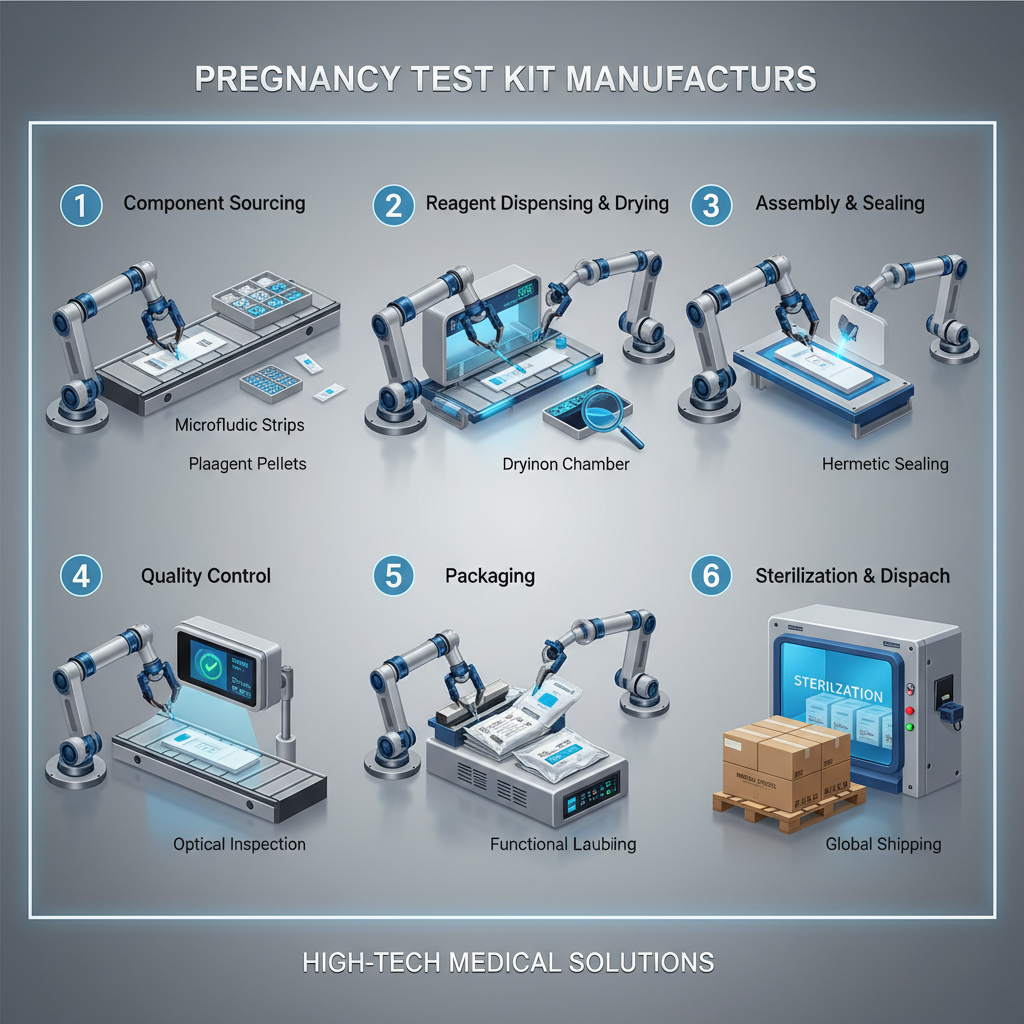
Moreover, the manufacturing environment itself must be a controlled space. Dust-free cleanrooms and precision humidity control are non-negotiable for high-tier producers. Because the nitrocellulose membrane is highly sensitive to environmental moisture, the process of "striping" the antibodies must occur under optimized conditions to prevent premature degradation of the reagents.
Finally, the integration of quality assurance (QA) protocols ensures that every lot is validated through blind testing. Leading manufacturers employ automated optical inspection systems to verify the consistency of the test and control lines, ensuring that only kits with a 99% or higher accuracy rate reach the end consumer.
Core Components of High-Sensitivity Tests
To achieve professional-grade results, pregnancy test kit manufacturers focus on the synergy between the sample pad and the conjugate pad. The sample pad must be engineered to filter out impurities from the urine sample while maintaining a consistent flow rate, ensuring that the hCG molecules are delivered evenly to the detection zone.
The choice of the nitrocellulose membrane is where the expertise of pregnancy test kit manufacturers truly shines. The pore size of the membrane dictates the capillary flow speed; a membrane that is too fast may not allow enough time for the antibody-antigen binding, while one that is too slow can lead to incomplete migration and invalid results.
Lastly, the plastic cassette housing provided by specialized manufacturers protects the internal strips from contamination and prevents leakage. By using medical-grade ABS plastic, producers ensure that the device remains structurally sound during shipping and handling, preserving the integrity of the diagnostic reagents inside.
Comparative Performance of Production Methods
Different pregnancy test kit manufacturers employ varying methodologies to optimize sensitivity and cost. Some rely on traditional manual dispensing for small-batch specialized tests, while industry leaders utilize high-speed automated dispensers that can apply reagents with microliter precision, significantly reducing waste and increasing batch-to-batch consistency.
The balance between "Early Detection" (lower mIU/mL threshold) and "Cost Efficiency" is a primary driver of innovation. By comparing different antibody clones and gold-nanoparticle sizes, manufacturers can fine-tune the visual intensity of the positive line, making it easier for the user to interpret the result accurately.
Comparative Efficiency of Pregnancy Test Kit Manufacturers' Methods
Global Applications and Market Reach
The application of products from pregnancy test kit manufacturers spans across diverse healthcare settings. In developed markets, the focus is often on "ultra-early" detection kits sold in pharmacies, where consumers demand high sensitivity and sleek packaging. Conversely, in clinical settings, these tests are used as rapid screening tools to prioritize patients for ultrasound or blood-based hCG quantification.
In emerging economies, the role of these manufacturers is even more critical. They provide low-cost, high-volume diagnostic solutions for rural clinics and mobile health units. By implementing robust stabilization techniques, they ensure the tests remain effective in high-temperature and high-humidity environments without the need for constant refrigeration, making maternal health screening a reality in the most remote industrial or agricultural zones.
Long-Term Value of Quality Certification
For distributors and healthcare providers, partnering with certified pregnancy test kit manufacturers offers significant long-term risk mitigation. Certification such as CE marking or FDA clearance isn't just a legal requirement; it is a guarantee that the manufacturer has implemented a comprehensive Quality Management System (QMS). This reduces the likelihood of costly product recalls and protects the brand reputation of the seller.
Beyond legal compliance, quality certification reflects a commitment to ethical manufacturing. Top-tier producers ensure that their raw material sourcing is transparent and that their waste management processes minimize the environmental impact of plastic and chemical runoff. This commitment to sustainability adds intangible value, appealing to the modern, eco-conscious consumer.
Ultimately, the reliability of a test kit translates directly into emotional security for the user. When a manufacturer prioritizes precision over profit, they provide a service that preserves dignity and trust. The logical value of a 99% accuracy rate is clear, but the emotional value of a confident, correct result is immeasurable.
Future Trends in Pregnancy Diagnostic Tech
The landscape for pregnancy test kit manufacturers is currently shifting toward digitalization. We are seeing the rise of "smart" cassettes that can be scanned by a smartphone app to eliminate human error in reading faint lines. This integration of AI-driven image analysis allows for a more objective interpretation of the results and can even provide the user with immediate guidance on the next steps for prenatal care.
Sustainability is another major frontier. Many manufacturers are exploring biodegradable polymers for the plastic housing and exploring the use of synthetic antibodies to replace animal-derived reagents. This transition not only reduces the carbon footprint but also enhances the stability of the tests, as synthetic antibodies can be engineered for higher thermal resistance.
Furthermore, the move toward multiplexing is gaining momentum. Future iterations from leading manufacturers may allow for the simultaneous detection of hCG and other markers, such as progesterone, providing a more comprehensive snapshot of early pregnancy health in a single, rapid test.
Analysis of Technological Evolution in Pregnancy Test Manufacturing
| Innovation Phase |
Primary Technology |
Impact on Accuracy |
Environmental Rating (1-10) |
| Traditional LFA |
Colloidal Gold / Nitrocellulose |
Standard (98%) |
4 |
| High-Sensitivity |
Monoclonal Antibody Optimization |
High (99.5%) |
5 |
| Digital Integrated |
Optical Sensor / App Sync |
Very High (99.9%) |
6 |
| Eco-Friendly Line |
Biodegradable PLA Housing |
Standard (98%) |
9 |
| Synthetic Reagent |
Peptide-based Capture Agents |
High (99.2%) |
8 |
| Multiplex Rapid |
Multi-line LFA Detection |
Comprehensive |
7 |
FAQS
Manufacturers employ a combination of high-affinity monoclonal antibodies and precise gold-conjugate concentrations. They utilize automated dispensing systems to ensure consistent reagent loading on the nitrocellulose membrane and conduct rigorous lot-by-lot validation testing against known hCG concentrations to guarantee a sensitivity typically ranging from 10 to 25 mIU/mL.
The gold standards are ISO 13485 (Medical Devices - Quality Management Systems), CE marking for the European market, and FDA clearance for the US market. These certifications ensure that the pregnancy test kit manufacturers follow strict protocols for safety, efficacy, and sterile production environment maintenance.
Yes, leading manufacturers are transitioning toward using PLA (Polylactic Acid) or other biodegradable plastics for the cassettes. Additionally, there is a move toward reducing chemical waste during the strip-dyeing process and implementing recyclable packaging to lower the environmental footprint of disposable diagnostic tests.
The speed of the result is primarily determined by the pore size of the nitrocellulose membrane. Manufacturers optimize the "wicking" speed to ensure the sample moves quickly enough for a fast result, but slowly enough to allow the hCG molecules to bind effectively to the antibodies. High-end manufacturers balance this flow rate to achieve accuracy without sacrificing speed.
False positives are minimized by using highly specific monoclonal antibodies that only react to the beta subunit of the hCG hormone. Manufacturers also implement strict quality controls to ensure no cross-contamination occurs during the assembly process and that the "Control Line" is perfectly calibrated to validate the test's functionality.
Many pregnancy test kit manufacturers offer OEM/ODM services. This includes customizing the sensitivity threshold (e.g., 10mIU vs 25mIU), modifying the cassette design, and providing private labeling for pharmacy brands or healthcare networks to meet specific market needs.
Conclusion
The role of pregnancy test kit manufacturers is fundamental to the global healthcare infrastructure, combining precision biochemistry with scalable industrial engineering. By focusing on high-sensitivity reagents, rigorous ISO certifications, and a commitment to quality control, these manufacturers ensure that early pregnancy detection is accurate, accessible, and reliable for millions. From the meticulous selection of nitrocellulose membranes to the implementation of digital reading technologies, the industry continues to evolve to meet the rising demands of both clinical and consumer markets.
Looking forward, the integration of sustainable materials and AI-enhanced diagnostics will define the next generation of reproductive health tools. For healthcare providers and distributors, the key to success lies in partnering with manufacturers who prioritize transparency, innovation, and stringent quality standards. As the industry moves toward a more eco-friendly and digitally connected future, the ultimate goal remains unchanged: empowering individuals with the most accurate health information possible. Visit our website for more professional solutions: www.prisesbio.com